

Oxygen Mask
On dark humor, self-care, and what it sometimes takes to survive

I recently came across an old memory on Facebook—of a moment during a call night that captured the absurdity at the core of medical training. Some details are fictionalized, but the emotional center is true.
I held the oxygen mask to my patient’s face, waiting for her to take a breath. She seemed suspended in animation, as though frozen in time.
Her heart stood out starkly against her pale chest, and her dark eyes stared blankly ahead. I waited, but she wouldn’t breathe.
“That working?” asked Mallory with raised eyebrows, from her chair across the room.
Next to her, Joe laughed.
I laughed, too.
“What?” I asked. “You don’t think she’ll make it?”
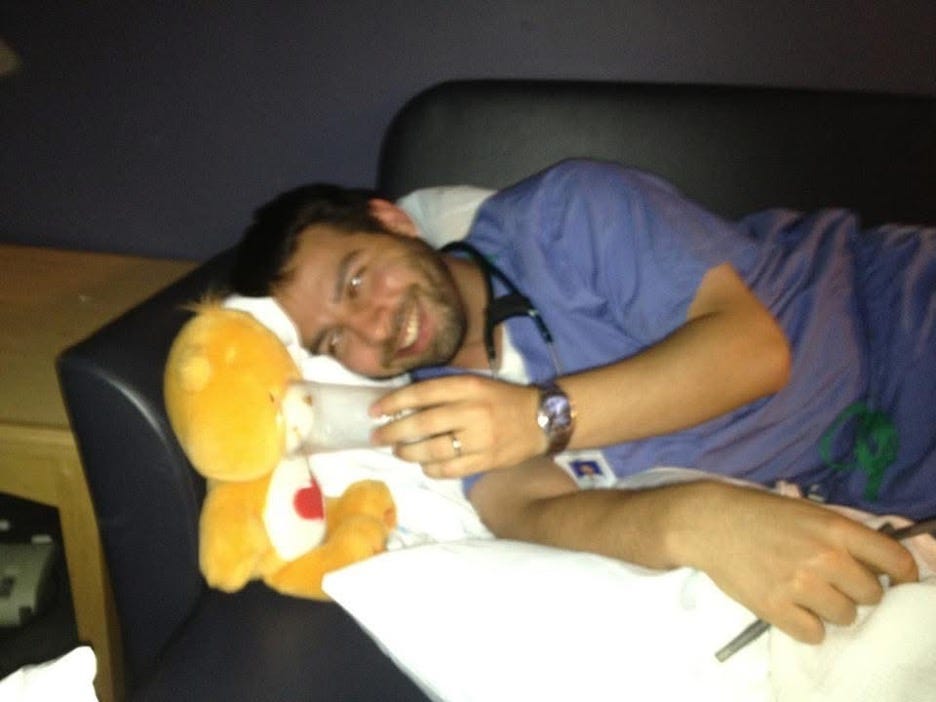
I pulled the plastic cup away from the yellow teddy bear’s face. I’d found the stuffed animal on the couch in our senior resident call room—a source of entertainment in a rare quiet moment in the middle of a night on call.
The moment was absurd. One might even say profane. We, obviously, thought it was hilarious.
But that’s the thing about medicine, particularly during training. It can be absurd. Some moments are profane. It’s too much to process, and sometimes we laugh. Other times, we cry.
Like when you’re on call on Christmas on the oncology service, and your fiancée is across the country with a family member who is sick with cancer.
Like when you explain to a mother that her son’s body is still warm, and his heart is still beating, but the boy she knew and loved is gone forever.
Or when you lie awake late at night wondering if your patient would still be alive if you’d just ordered the right medicine, or if your procedural technique had been better.
We sometimes wear dark humor as armor—but I’m not sure if it’s to keep difficult feelings from getting inside us, or those already inside from bursting out. From the outside, it can appear callous, if you can’t see the reasons behind it.
That night with the teddy bear, I was the medical senior for The House—I’d heard about all the sick patients in the hospital, and I ran the code team.
Just before trying to resuscitate a teddy bear, I’d come from a code where I’d been unable to resuscitate a real, human patient.
I declared time of death. We had a moment of silence. I filled out the death paperwork, careful not to make any mistakes—if I did, I’d have to do it over again. I called the family. They were out of town.
When I retreated to the call room to clear my head, Mallory and Joe were there.
“Were you at that code?” asked Mallory.
I nodded.
“Get ROSC?” asked Joe.
I shook my head.
As I sank down into the brown cushions with worn corners, I noticed the teddy bear lying face-down on the other end of the couch.
“Well,” I said, dropping the cup from the stuffed animal’s face. “Think I need to tube her.”
Mallory smiled with her eyes, the corners of her mouth barely upturned. She didn’t laugh.
Just before the overhead announcement, my hip buzzed and beeped. It was the code pager.
“Gotta run,” I said, standing up.
The speakers echoed with the familiar voice of one of the overnight hospital operators.
“Code blue, 7 north, room 728.”
“Shit,” I said, moving quickly toward the open door. “I know that patient.”
I took long strides on my way to the code. My head had been filled with axioms from those who trained me.
Walk, don’t run.
Take your own pulse.
Put your own oxygen mask on first.
We’re told to practice self-care in medicine. That we can’t be there for others if we’re not there for ourselves. That we can’t pour from an empty cup. To put our own oxygen masks on first.
But it can be hard to find time for refills when the code pager keeps beeping, hours blur in early morning, and ROSC feels unattainable.
So sometimes, we tell jokes. Please excuse us if you overhear.